TLDR
Cell penetration is the ability of a peptide or peptide-cargo construct to associate with cells and become internalized. Tissue selectivity is preferential exposure or activity in a target tissue relative to non-target tissues. A convincing cell penetrating peptide tissue selectivity claim therefore requires evidence across the full delivery pathway: circulation, clearance, vascular access, tissue retention, uptake by the intended cell type, intracellular trafficking, cargo release, target engagement, and functional activity. Strong uptake in cultured cells establishes only part of that sequence.
The central problem in cell penetrating peptide tissue selectivity is that the physicochemical properties promoting uptake—often positive charge, hydrophobicity, or membrane interaction—may operate across many cell types rather than only in the desired tissue. Reviews identify limited cell selectivity as a central constraint for broadly transducing cationic and hydrophobic CPPs. A peptide can therefore be an effective permeability tool without being an effective systemic targeting ligand.
Cellular entry and tissue delivery answer different questions
A cell-penetrating peptide, or CPP, is typically a short peptide capable of promoting cellular uptake of itself or an attached cargo. That definition concerns interaction at the cellular level. It does not specify which organ encounters the construct after administration, which cell population internalizes it, or whether the attached cargo reaches its required intracellular compartment.
A useful way to separate the concepts is to ask four different questions:
| Delivery concept | Question being tested | What a positive result does not establish |
|---|---|---|
| Cellular uptake | Does material become associated with or internalized by cells? | Cytosolic delivery, tissue preference, or functional cargo activity |
| Tissue exposure | Does a tissue contain detectable construct-associated material? | Uptake by the intended cell type or presence of intact cargo |
| Cell-type selectivity | Do target cells accumulate more material than relevant non-target cells? | Escape from endosomes or engagement of an intracellular target |
| Functional intracellular delivery | Does intact cargo reach the required compartment and produce a specific effect? | A favorable whole-body safety margin or clinical benefit |
These categories are related, but they are not interchangeable. Even the first category needs careful measurement: fluorescence associated with a cell may represent membrane binding rather than internalization. The experimental distinction is covered in more detail in this guide to cell-surface binding and true CPP internalization.
Systemic delivery is a multistage process
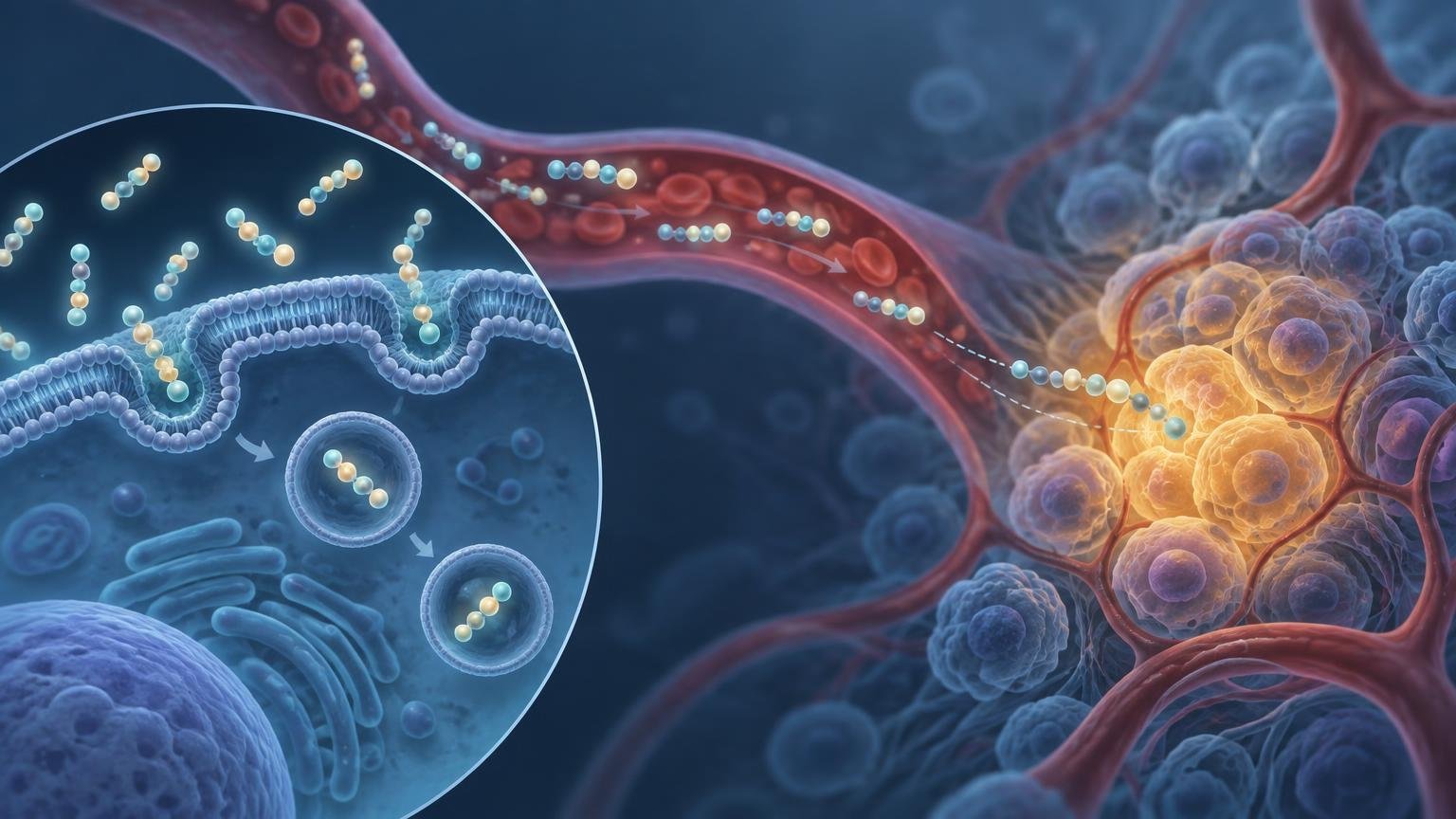
When a CPP construct is administered systemically, it encounters a series of barriers that are absent or greatly simplified in a culture dish. The construct must remain sufficiently intact in biological fluids, avoid clearance long enough to reach the relevant vasculature, cross or interact with the tissue barrier, distribute through the tissue, contact the intended cells, enter those cells, and release an active cargo in the correct subcellular location.
- Circulation and stability: plasma proteins, proteases, aggregation, and interactions with blood cells can alter the construct before it reaches the target.
- Clearance and organ exposure: renal filtration, hepatic uptake, and other clearance processes can dominate the biodistribution profile.
- Vascular access: the construct must reach and interact with the relevant vascular surface, then cross the applicable barrier when extravascular delivery is required.
- Tissue retention: material must remain in the tissue rather than merely pass through its blood volume.
- Cell-type access: the intended cells must be physically accessible within a heterogeneous tissue.
- Internalization and trafficking: uptake must be followed by delivery to the cytosol, nucleus, or another required compartment.
- Cargo integrity and function: the attached molecule must remain intact or be released appropriately and retain biological activity.
Each stage can become the limiting step. Improving membrane interaction may enhance one late stage while leaving circulation, clearance, or tissue access unchanged. It can also increase uptake by non-target cells, creating broader exposure rather than greater selectivity.
Why cell-culture uptake can overpredict in-vivo targeting
Culture experiments commonly expose one cell type directly to a defined CPP concentration. The peptide does not first have to survive circulation or compete among organs. Exposure may also be relatively uniform, whereas tissue concentrations after systemic administration vary over time and depend on blood flow, vascular permeability, clearance, and construct chemistry.
A comparative mouse study illustrates the gap. Established CPPs showed strong uptake in vitro, but after intravenous administration they underwent rapid blood clearance, transiently accumulated in well-perfused organs, and showed low tumor accumulation and limited tumor specificity under the reported conditions. The PubMed record for the comparative pharmacokinetic study provides the study details. More recent CPP development work likewise treats pharmacokinetics, biodistribution, and toxicology as separate questions rather than consequences that can be inferred from cellular uptake.
The final formulation matters as much as the CPP sequence. Adding a protein, oligonucleotide, nanoparticle, fluorophore, chelator, or drug can change size, charge, hydrophobicity, protein binding, stability, uptake route, and clearance. Linker chemistry may determine whether the cargo remains attached in blood or is released inside a cell. Consequently, biodistribution measured for an unconjugated CPP should not be assumed to describe the CPP-cargo construct.
A tissue signal is not proof of intracellular cargo delivery
Whole-organ fluorescence, radioactivity, or mass-spectrometric signal can establish that detectable material is associated with a tissue sample. Without additional controls, it may not reveal the identity or location of that material. Possible contributors include intact construct, free label, degraded fragments, material retained in blood vessels, extracellular deposition, membrane-bound peptide, endosomal material, and cargo released outside the intended cells.
Subcellular localization is especially important for cargos acting in the cytosol or nucleus. In one in-vivo study of activatable CPPs, investigators reported predominantly punctate, perinuclear signal and did not detect nuclear uptake in intact living cells under the stated experimental conditions. That pattern is informative because punctate localization is consistent with sequestration in intracellular vesicles. It does not by itself demonstrate free cytosolic or nuclear access.
The more important distinction is that internalization is not the same as productive delivery. Endosomal uptake can produce an impressive microscopy signal while leaving little active cargo available to an intracellular target. Evidence of function should therefore be paired with localization and integrity measurements rather than used as a substitute for them.
Research strategies for improving selectivity
Tissue-homing or receptor-binding ligands
A tissue-homing ligand is selected or designed to bind a molecular feature enriched and accessible in the target tissue. This differs from a generic CPP, whose primary role is to promote entry after contact with a cell. The two functions can be combined, but each should be tested independently.
An early in-vivo phage-display study identified peptides showing preferential localization to brain or kidney vasculature in mice. The work supports screening directly in the physiological environment for vascular binding rather than assuming that cell penetration will create organ preference. It does not mean that an animal-selected sequence will retain the same distribution in humans; vascular targets, binding partners, accessibility, and pharmacology can differ by species.
Activatable or masked CPPs
Activatable CPP designs attempt to suppress uptake during circulation and restore it near a local trigger. In one established design, a negatively charged inhibitory segment masks a positively charged CPP. Cleavage of a connecting linker by local protease-related activity separates or disables the mask, permitting stronger cellular interaction. Preclinical mouse studies support this general design principle.
Reported construct modifications reduced some liver and kidney background while supporting protease-dependent probe accumulation in mouse tumor models. This is evidence of model-specific enrichment, not proof of human tissue selectivity. Off-target activation remains possible wherever the activating enzyme is present, accessible, or induced by unrelated inflammation or tissue remodeling. Circulating cleavage and incomplete masking can also reduce the intended contrast.
Carrier and cargo engineering
A CPP can be placed on a liposome, polymeric carrier, protein, or other delivery architecture. Such systems may alter circulation time, multivalent binding, cargo protection, and release. They also create new variables: carrier size, surface density, orientation of the peptide, stability of the conjugation, aggregation, and uptake by clearance organs. The complete formulation—not the CPP in isolation—is the relevant experimental unit.
Local administration
Administration near or within a target tissue can increase local exposure without demonstrating intrinsic tissue homing. That can be a useful delivery strategy, but it should be described accurately as route-dependent localization. Systemic tissue selectivity implies that the construct preferentially reaches or acts in the target after navigating whole-body distribution.
How to evaluate a tissue-selectivity claim
A strong assessment compares target exposure with biologically relevant non-target exposure and identifies what the measured signal represents. The following checklist helps separate a preliminary biodistribution observation from evidence of productive delivery:
- Test the final CPP-cargo construct, including its actual linker, label, carrier, and formulation.
- Measure concentration over time in blood, target tissue, major clearance organs, and safety-relevant non-target tissues.
- Report both absolute exposure and an appropriate target-to-background comparison; a favorable ratio can still conceal low target exposure or substantial off-target burden.
- Use analytical methods capable of distinguishing intact construct from free label and degradation products.
- Account for tissue blood content or vascular retention when interpreting whole-organ measurements.
- Identify the cell populations containing the signal through histology, cell sorting, imaging, or another cell-resolved method.
- Use extracellular quenching, stripping, fractionation controls, or orthogonal imaging where appropriate to distinguish surface association from internalization.
- Determine whether material reaches the required intracellular compartment rather than remaining in endosomes.
- Measure cargo-specific target engagement or activity and include controls for nonspecific toxicity.
- Compare the targeted or activatable construct with suitable controls, such as a nonbinding sequence, noncleavable linker, permanently masked construct, unconjugated cargo, or uptake-competent CPP lacking the targeting element.
No single assay answers every question. Whole-organ imaging is useful for distribution, but chemical analysis may be needed for molecular integrity. Microscopy can reveal localization, but quantitative tissue analysis is needed for exposure. A functional assay can show a biological response, but loss-of-function, competition, rescue, or target-engagement experiments may be required to connect that response to the proposed mechanism.
Translational limits should remain explicit
Preclinical selectivity is conditional on the tested sequence, cargo, species, disease model, dose, schedule, route, and observation time. A receptor or enzyme that appears enriched in one model may be less selective, less accessible, or more heterogeneous in human tissue. Repeated administration may also produce a different exposure or tolerability profile from a single-dose experiment.
Accordingly, disease-directed language should track the evidence level. Enrichment in a mouse model supports further investigation of targeting in that model. It does not establish human efficacy, safety, or a usable therapeutic window. The evidence must advance from tissue association to intact delivery, cell-type localization, intracellular availability, target engagement, functional effect, and safety-relevant exposure.
A historical Celtek perspective
Celtek Bioscience has a documented history involving cell-permeable peptide agents and intracellular signaling research. U.S. Patent 7,408,022 lists Celtek Bioscience as assignee and describes peptide agents related to NF-κB-associated anti-apoptotic pathways. A patent records technical disclosures and legal claims; it is not evidence of therapeutic efficacy.
A 2020 preclinical paper also listed a Celtek Bioscience affiliation for Yao-Zhong Lin in research on peptide-modified liposomal irinotecan. That dated research record provides relevant historical context, but it should not be interpreted as evidence of human clinical benefit. Readers interested in the associated program history can review the evidence-led account of CB5005 design and preclinical research.
Conclusion
Efficient cellular entry solves only one part of biomolecular delivery. Tissue selectivity is a whole-construct, whole-body property shaped by pharmacokinetics, vascular access, tissue retention, cell-type recognition, intracellular trafficking, and cargo function.
The practical next step is to define the desired delivery endpoint before choosing an assay. If the goal is systemic tissue-selective cytosolic delivery, measure the final construct across target and non-target tissues, verify its molecular integrity, identify the cells and compartments reached, and demonstrate cargo-specific target engagement. Without that chain of evidence, the most defensible conclusion is cellular uptake or tissue association—not selective functional delivery.
References
- Cell-Type Specific Penetrating Peptides: Therapeutic Promises and Challenges – PMC
- The pharmacokinetics of cell-penetrating peptides – PubMed
- Pharmacokinetics, biodistribution and toxicology of novel cell-penetrating peptides – PubMed
- Systemic in vivo distribution of activatable cell penetrating peptides is superior to cell penetrating peptides – PMC
- Organ targeting in vivo using phage display peptide libraries.
- In vivo characterization of activatable cell penetrating peptides for targeting protease activity in cancer – PMC
- US7408022B2 – Composition and method for increasing apoptosis in cancer cells – Google Patents
- Treatment of Lung Cancer by Peptide-Modified Liposomal Irinotecan Endowed with Tumor Penetration and NF-κB Inhibitory Activities.