
Biotech Research, Cell Delivery and Preclinical Science
Explore molecular and cellular biology, intracellular biomolecular delivery, peptide and protein science, gene-synthesis concepts, analytical methods, and preclinical research. Learn what experiments measure, how mechanisms are evaluated, and where evidence supports a conclusion or leaves uncertainty.
Biotechnology Research, Cellular Delivery and Preclinical Science
Celtek Bioscience is a scientist-led publication about biotechnology research, molecular and cellular biology, biomolecular delivery, and preclinical science. Written for researchers, laboratory scientists, biotechnology professionals, students, and technically curious readers, it explains how biological systems are studied and how experimental evidence should be interpreted. The emphasis is on mechanisms, measurements, controls, and conclusions rather than promotional shorthand or oversimplified claims.
Biological questions often span several levels at once. A molecule may bind an intended target in a biochemical assay yet behave differently in a living cell, where membranes, degradation, trafficking, localization, and competing interactions affect the outcome. This publication follows those transitions carefully, connecting molecular properties with cellular behavior while identifying where the evidence becomes indirect, model-dependent, or uncertain.
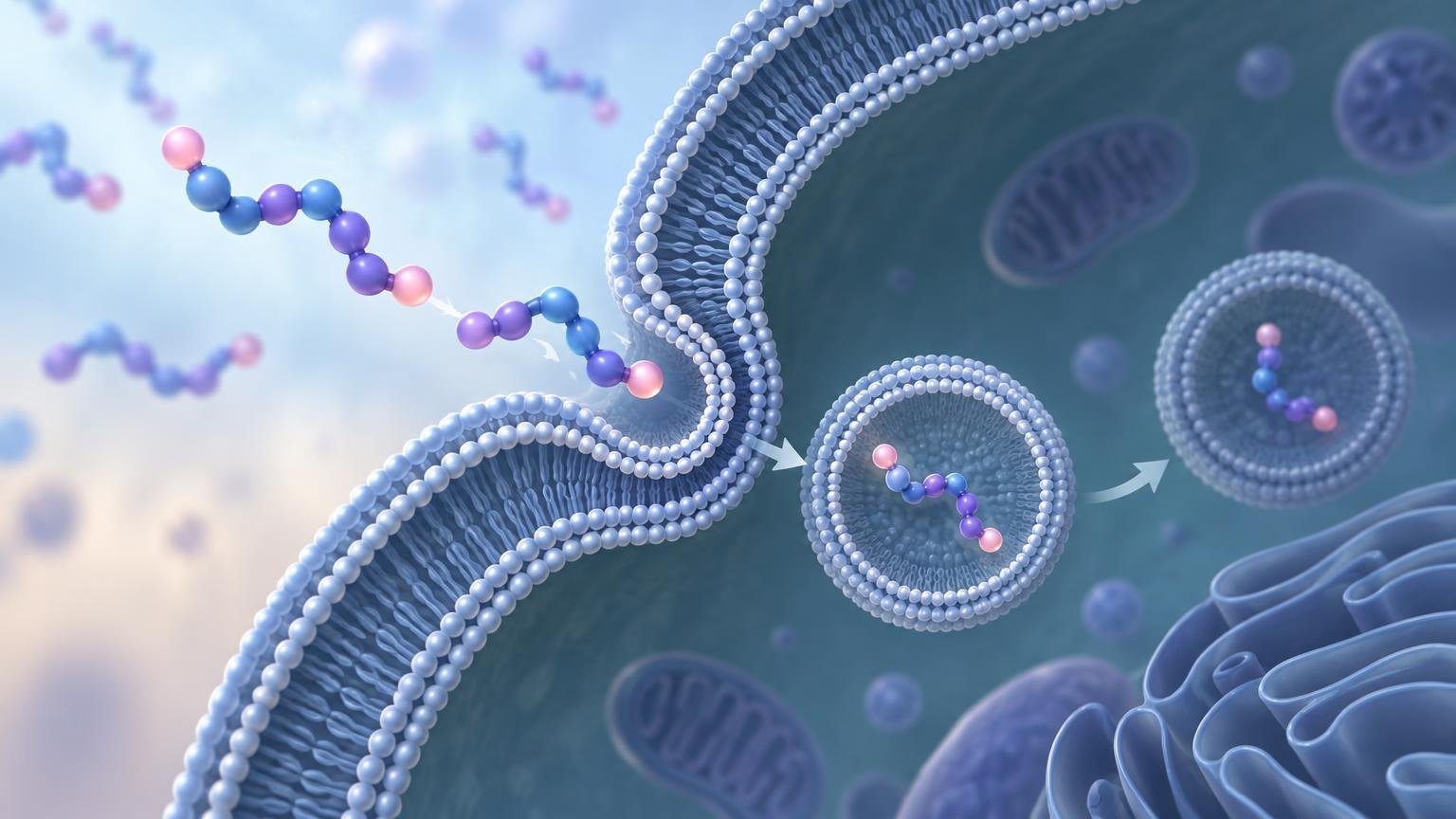
Intracellular delivery receives particular attention because the phrase entered the cell can hide several distinct events. Cell-surface association, internalization, endosomal retention, cytosolic release, nuclear localization, target engagement, and functional activity are separate experimental questions. Coverage examines how researchers distinguish these stages and which controls help reveal extracellular signal, fixation artifacts, nonspecific toxicity, or misleading fluorescence.
Peptide and protein science is approached through structure, function, conjugation, folding, stability, localization, and analytical characterization. The publication examines how cargo size, charge, linker design, release mechanisms, and cell type can change delivery behavior. Chromatographic purity, molecular identity, peptide content, potency, and biological activity remain distinct properties, even when several are relevant to the same research material.
Nucleic-acid coverage separates gene synthesis, oligonucleotide synthesis, cloning, sequence design, codon optimization, expression, and gene editing. These processes can connect within one research workflow, but they do not answer the same question. A designed sequence may be correct while expression, protein folding, localization, and biological function still depend on the host system, construct design, and experimental conditions.
Across drug discovery and preclinical research, the central task is to match each conclusion to what the model measures. Biochemical assays, cultured cells, ex vivo systems, animal models, and human studies provide different forms of evidence. Moving between them requires more than a stronger signal; it requires a clear biological rationale, relevant exposure, suitable controls, reproducibility, and an honest account of translational limits.
Latest Research and Scientific Guides
Pharmacokinetics vs Biodistribution in Peptide Delivery Studies
Pharmacokinetics describes how measured peptide concentration changes over time, while biodistribution adds tissue location. Learn what each study can establish, where common assays…
Read moreNuclear vs Cytoplasmic Western Blots for NF-kB Translocation
A practical guide to fractionating cells, validating nuclear and cytoplasmic purity, normalizing p65 signals, troubleshooting contamination, and limiting conclusions to what an NF-κB…
Read moreDirect Translocation vs Endocytosis: Two Routes Proposed for Cell-Penetrating Peptides
Cell-penetrating peptides may cross the plasma membrane directly, enter through endocytosis, or use both routes. The apparent mechanism depends on the peptide, cargo,…
Read moreFrom Cell Culture to Animal Models to Human Trials: How Biotechnology Evidence Changes at Each Step
A mechanism-first guide to the biotechnology evidence ladder, from biochemical assays and cultured cells to nonclinical models, human trials, regulatory review, and post-market…
Read moreMechanisms, Methods and Evidence in Context
A useful scientific explanation begins with the biological question. What molecule, pathway, compartment, or phenotype is under investigation? What interaction is proposed? Which experiment directly tests it, and which observations merely support an inference? By organizing coverage around these questions, Celtek Bioscience helps readers move from an assay readout to the strongest conclusion that the underlying design can reasonably support.
Research-method coverage explains not only how a technique works, but what its output represents. Western blotting can address protein abundance, apparent molecular weight, or phosphorylation only under appropriate conditions. Flow cytometry depends on marker selection, gating, and controls. Microscopy can show spatial patterns, while fractionation, binding assays, sequencing, PCR, and functional assays answer adjacent but different questions and benefit from complementary evidence.
The same discipline applies to signaling pathways such as NF-kB. Detecting a pathway component, observing nuclear localization, measuring reporter activity, and demonstrating pathway-dependent function are not interchangeable results. Coverage connects pathway diagrams with experimental design, helping readers evaluate baseline activation, stimulus responses, temporal effects, inhibitor studies, genetic perturbations, and alternative explanations for an observed cellular phenotype.
Drug-discovery topics extend from target validation and assay development to mechanism-of-action studies, biomarkers, and preclinical models. The publication distinguishes a promising hypothesis from demonstrated activity and demonstrated activity from clinically meaningful evidence. Cell-based effects do not automatically establish in vivo performance, and animal-model findings do not establish effectiveness in people. Each stage answers a narrower question within a larger development process.
Historical research is treated with the same attention to dates, source type, and evidentiary limits. Descriptions of named programs, patents, grants, compounds, or development milestones need enough context to show what was reported at a particular time. Company-reported findings, patent claims, peer-reviewed results, grant records, and current program status represent different kinds of information and should not be collapsed into one narrative.
The goal throughout is practical scientific understanding. Readers should be able to identify what was measured, recognize the controls that matter, separate direct evidence from interpretation, and see which experiment would address the next unanswered question. Whether the subject is cellular uptake, peptide cargo, gene design, signaling, analytical characterization, or preclinical translation, precision should make the science clearer, more specific, and more useful.