TLDR
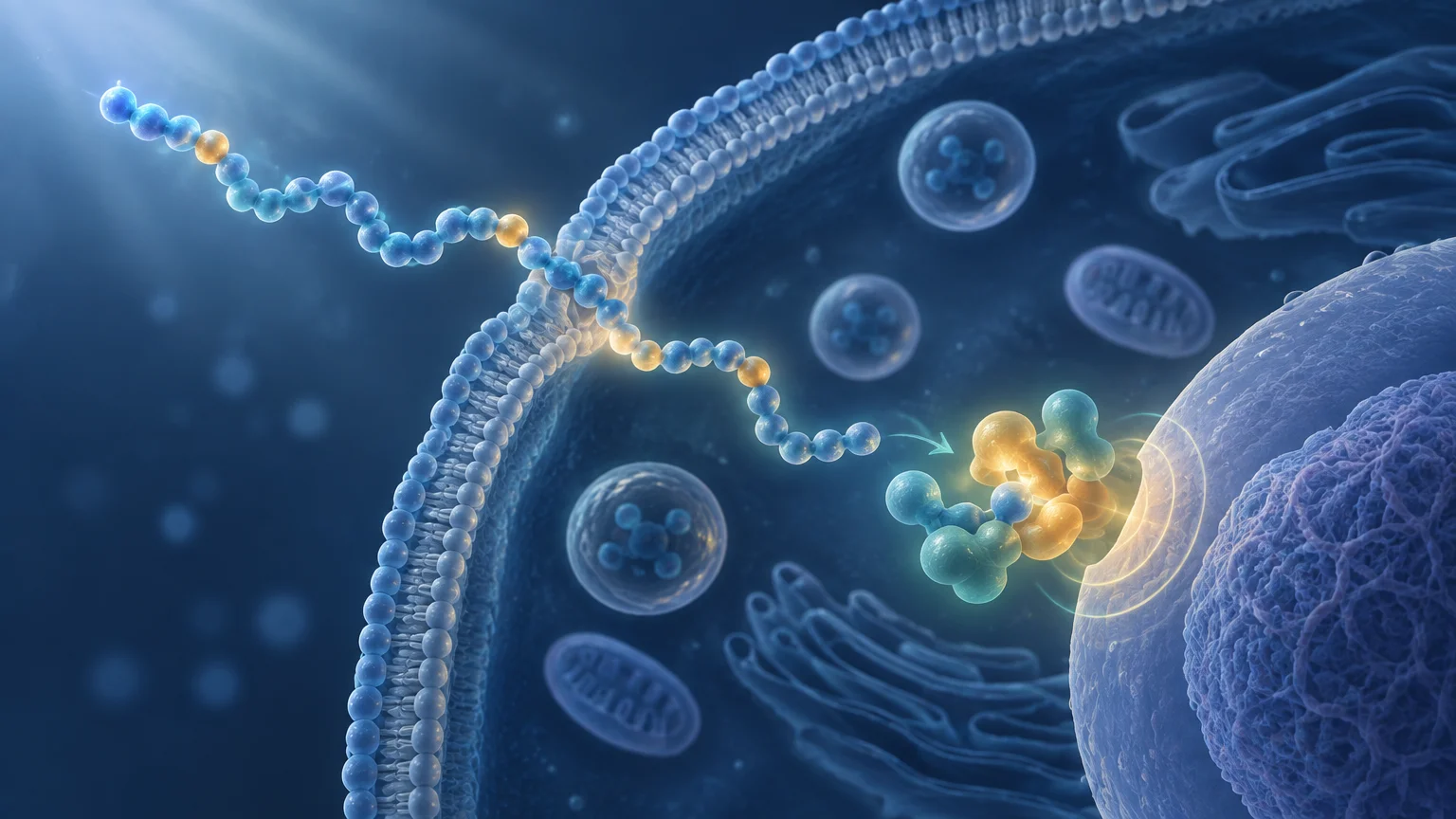
The CB5005 peptide is a 21-amino-acid research peptide designed to combine a membrane-permeable segment with a segment derived from an NF-κB nuclear localization sequence. A 2008 US patent disclosed its early design and cell experiments. Peer-reviewed studies published in 2016, 2018, and 2020 subsequently examined free CB5005 or CB5005-modified drug carriers in cells, tumor spheroids, and mouse models. These studies provide a preclinical research record—not evidence of safety, effectiveness, blood-brain-barrier transport, or therapeutic benefit in people.
The important question about the CB5005 peptide is not simply whether it entered experimental cells. Its research rationale spans several distinct steps: membrane interaction, internalization, tissue or spheroid penetration, nuclear localization, interference with an NF-κB-related process, drug delivery, and a downstream biological response. Each step requires different evidence, and success at one stage does not establish the next.
A chronological reading also prevents results from different formulations from being merged. The 2016 work studied CB5005 alongside doxorubicin, whereas the 2018 and 2020 reports investigated CB5005 attached to liposomal drug carriers. Carrier-conjugated findings cannot automatically be assigned to the unconjugated peptide.
What is the CB5005 peptide?
The 2016 Acta Biomaterialia paper reports CB5005 as a 21-residue peptide with the sequence KLKLALALALAVQRKRQKLMP. The authors divide it into an 11-residue membrane-permeable segment, KLKLALALALA, called CB5005M, and a 10-residue NF-κB nuclear-localization-sequence-derived segment, VQRKRQKLMP, called CB5005N. Readers can examine the indexed paper through the PubMed record for the 2016 CB5005 study.
That construction gives CB5005 a dual-function design rationale. CB5005M is intended to support access across cellular barriers, while CB5005N supplies the NF-κB-related and nucleus-targeting component. The complete peptide was therefore proposed as both a delivery-active molecule and an inhibitor of NF-κB nuclear translocation. This is a design hypothesis evaluated in particular experimental systems, not proof that the peptide universally inhibits NF-κB in every cell type or physiological setting.
The nuclear localization sequence is relevant because regulated movement into the nucleus is central to canonical NF-κB signaling. In a simplified pathway, NF-κB dimers are retained outside the nucleus by IκB proteins; pathway activation can lead to IκB degradation and allow NF-κB nuclear entry. The broader sequence of events is explained in the guide to TNF-α and canonical NF-κB signaling, while the roles of the major p50 and RelA/p65 subunits are covered in the classic NF-κB heterodimer.
A sequence derived from an NF-κB localization element could, in principle, interfere with transport-related interactions. But sequence resemblance and intended mechanism are only a starting point. Strong mechanistic evidence would ideally connect the peptide to a defined molecular interaction, altered localization of the relevant NF-κB components, pathway-specific transcriptional changes, and appropriate loss-of-function or rescue controls. A downstream viability or tumor-size result alone cannot identify which molecular step caused the effect.
The foundational patent record
The early documentary record appears in US 7,408,022 B2, titled “Composition and Method for Increasing Apoptosis in Cancer Cells.” The patent lists Yao-Zhong Lin and Claudia Budu as inventors and Celtek Bioscience LLC as the original assignee. Its record gives November 9, 2004 as the priority date and August 5, 2008 as the issue date. A broader dated account of the organization’s grants, patent work, and later publications is available in the history of Celtek Bioscience and CB5005.
In the patent, CB5005 is identified as SEQ ID NO: 4. The document describes in-vitro examples involving prostate-cancer cell lines and comparisons with SN50, another peptide associated with nuclear-transport inhibition. These examples help establish what was disclosed and how the inventors framed the compound at that time.
A patent nevertheless answers a different question from a peer-reviewed efficacy study. It documents an invention, claims, embodiments, and supporting examples within a legal and technical framework. It does not by itself demonstrate clinical effectiveness, regulatory approval, independent replication, or current development status. The patent examples are also cell experiments, not human findings.
The 2016 study: free peptide, cellular localization, and glioma models
The 2016 Acta Biomaterialia publication expanded the evidence into several preclinical model levels. It reported experiments on CB5005 uptake and nuclear localization in bEnd.3 mouse brain endothelial cells and U87 human glioma cells. It also examined penetration into three-dimensional U87 tumor spheroids, distribution of labeled peptide in animals, and CB5005 combined with doxorubicin in cell and nude-mouse glioma models.
These experiments addressed related but non-equivalent questions. A two-dimensional cell culture can test whether a fluorescent or otherwise detectable peptide becomes associated with cells and where the signal appears. A spheroid introduces a three-dimensional penetration problem. Animal imaging asks where a label is detected at the organism or tissue level. A tumor-model experiment evaluates a downstream response under the particular exposure, comparator, and model conditions.
The distinction between uptake and functional intracellular delivery is especially important. Apparent cell-associated fluorescence can include material bound to the plasma membrane, contained in endosomes, or released into the cytosol. Nuclear signal is more informative for a nucleus-directed design, but interpretation still depends on labeling chemistry, microscopy resolution, extracellular-signal controls, fixation conditions, and evidence that the labeled construct behaves like the unlabeled peptide.
Likewise, penetration into a spheroid is not the same as distribution through a human tumor. Spheroids model selected features of three-dimensional tissue, including diffusion barriers and cell-to-cell architecture, but they do not reproduce the complete vasculature, immune environment, metabolism, and physical heterogeneity of a human malignancy.
Animal distribution of a labeled peptide should also be separated from demonstrated transport of intact, functional CB5005 across the human blood-brain barrier. A detected label may represent intact peptide, degraded fragments, or a detached fluorophore unless chemical integrity is established. Species differences and disease-associated changes in vascular permeability further limit direct translation.
The 2018 study: CB5005-conjugated liposomal doxorubicin
A 2018 Journal of Controlled Release study changed the delivery system. Rather than evaluating only free CB5005 with a drug, the investigators attached CB5005 to PEGylated liposomes carrying doxorubicin or a fluorescent probe. In glioma-focused experimental systems, the authors reported greater glioma-cell uptake, spheroid penetration, nuclear delivery of doxorubicin, animal fluorescence-distribution findings, and longer survival in nude mice bearing intracranial glioblastoma relative to the study comparators.
The conjugated formulation matters mechanistically. A liposome changes particle size, drug encapsulation, circulation behavior, cellular entry, tissue distribution, and drug-release requirements. Surface-bound CB5005 could affect cell interaction or tissue penetration, but the complete result belongs to the peptide-linker-liposome-cargo system. It should not be described as evidence that unconjugated CB5005 alone produces the same distribution or antitumor effect.
Nuclear delivery of doxorubicin is also a cargo-specific endpoint. Doxorubicin acts on nuclear targets, so delivery into or near the nucleus can be functionally relevant. Yet fluorescence localization does not alone establish how much pharmacologically active drug reached its target, whether release from the carrier was required, or how much of the observed response resulted from altered exposure rather than NF-κB inhibition.
The 2020 study: CB5005-modified liposomal irinotecan
The 2020 Molecular Pharmaceutics paper applied a related carrier concept to a different cancer model and drug. Researchers studied CB5005-modified liposomes containing irinotecan in A549 non-small-cell lung-cancer cells and mouse xenografts. The authors reported increased uptake of the modified liposomes, changes in nuclear NF-κB-related protein levels in A549 cells, and improved antitumor findings in their mouse model.
This study broadened the formulation research beyond glioma and doxorubicin, but it did not convert the evidence into a general clinical claim. A549 cells are one experimental cell line, and a mouse xenograft is a controlled preclinical system. The result concerns a CB5005-modified irinotecan formulation under the tested conditions. It does not establish that free CB5005 has the same activity, that every CB5005-decorated carrier will behave similarly, or that the formulation is safe or effective in humans.
How the evidence levels should be separated
| Evidence level | What the CB5005 record examined | What it does not establish |
|---|---|---|
| Patent examples | Disclosed peptide sequences, proposed mechanisms, and in-vitro cancer-cell experiments. | Independent replication, clinical effectiveness, approval, or current program status. |
| Two-dimensional cell studies | Uptake, localization, pathway-related readouts, and responses under defined culture conditions. | Human tissue distribution, tolerability, or clinical benefit. |
| Tumor spheroids | Penetration through a three-dimensional glioma model. | Distribution through the full vascular and cellular complexity of a human tumor. |
| Mouse models | Distribution and antitumor or survival endpoints in particular glioma and xenograft experiments. | Human blood-brain-barrier transport, human safety, or treatment efficacy. |
| Liposomal formulations | Performance of CB5005-conjugated carriers containing doxorubicin or irinotecan. | Equivalent performance by unconjugated CB5005 or unrelated carrier designs. |
This hierarchy is not a dismissal of preclinical research. Cell, spheroid, and animal models answer necessary questions that cannot initially be addressed in people. The point is to preserve the level of the conclusion: an experimental result should be described as an experimental result, with the formulation and model attached.
The identified publications support the conclusion that CB5005 has been investigated as a dual-function peptide and as a targeting or functional component of drug-delivery formulations. They also show that researchers observed uptake, localization, penetration, pathway-related changes, and antitumor endpoints in defined preclinical models. They do not establish an approved use or a favorable benefit-risk profile in humans.
Questions the published record does not resolve
Several translational questions remain outside what these reports establish. They are not minor details; they determine whether an experimental delivery strategy can progress beyond proof-of-concept work.
- Chemical and proteolytic stability: How long does intact CB5005 persist in relevant biological fluids and tissues?
- Quantitative biodistribution: How much intact peptide or intact carrier reaches the intended tissue, and how much accumulates elsewhere?
- Intracellular availability: What fraction is surface-bound, endosomal, cytosolic, or nuclear at biologically relevant exposure?
- Mechanistic specificity: Are pathway and phenotype changes attributable to NF-κB-related interference, altered drug exposure, nonspecific membrane effects, or a combination?
- Safety margin: What effects occur in normal cells and tissues across repeated exposures?
- Immunogenicity: Does the peptide or peptide-decorated carrier provoke immune responses in models suited to evaluate them?
- Formulation reproducibility: Can peptide density, conjugation chemistry, drug loading, release behavior, and particle properties be controlled consistently?
- Independent replication: Do other laboratories reproduce the localization, pathway, distribution, and efficacy findings?
- Human translation: What pharmacokinetic, safety, dose-escalation, and clinical-outcome data would be required to evaluate the approach in people?
Controls should be matched to each question. Scrambled or segment-only peptides can test sequence dependence. Unmodified liposomes help isolate the contribution of CB5005. Free drug and free peptide controls distinguish formulation effects. Endosomal markers, cytosolic delivery assays, nuclear fractionation with purity controls, and direct target-engagement methods can determine where the construct goes and whether it reaches the proposed molecular machinery. Viability measurements should be accompanied by pathway and cell-death assays because reduced metabolic signal can reflect several processes besides apoptosis.
The strongest conclusion supported by the record
CB5005 is a documented 21-amino-acid, dual-segment research peptide with a membrane-permeable component and an NF-κB-NLS-derived component. Its history can be traced from a patent with early in-vitro examples to peer-reviewed preclinical studies involving free peptide, doxorubicin combinations, and CB5005-modified liposomal carriers containing doxorubicin or irinotecan.
The evidence is strongest for saying that these constructs were investigated and produced reported effects in particular cell, spheroid, and mouse systems. It is not sufficient to call CB5005 clinically proven, approved, safe, or effective as a human treatment. The practical next step for evaluating any new CB5005 claim is to identify the exact construct, cargo, model, endpoint, comparator, and evidence level. Without those details, “CB5005 worked” is too broad to be scientifically informative.
References
- Functionalized cell nucleus-penetrating peptide combined with doxorubicin for synergistic treatment of glioma.
- US7408022B2 – Composition and method for increasing apoptosis in cancer cells – Google Patents
- EP1827471B1 – Composition and method for increasing apoptosis in cancer cells – Google Patents
- Cell-permeable NF-κB inhibitor-conjugated liposomes for treatment of glioma – PubMed
- Treatment of Lung Cancer by Peptide-Modified Liposomal Irinotecan Endowed with Tumor Penetration and NF-κB Inhibitory Activities.