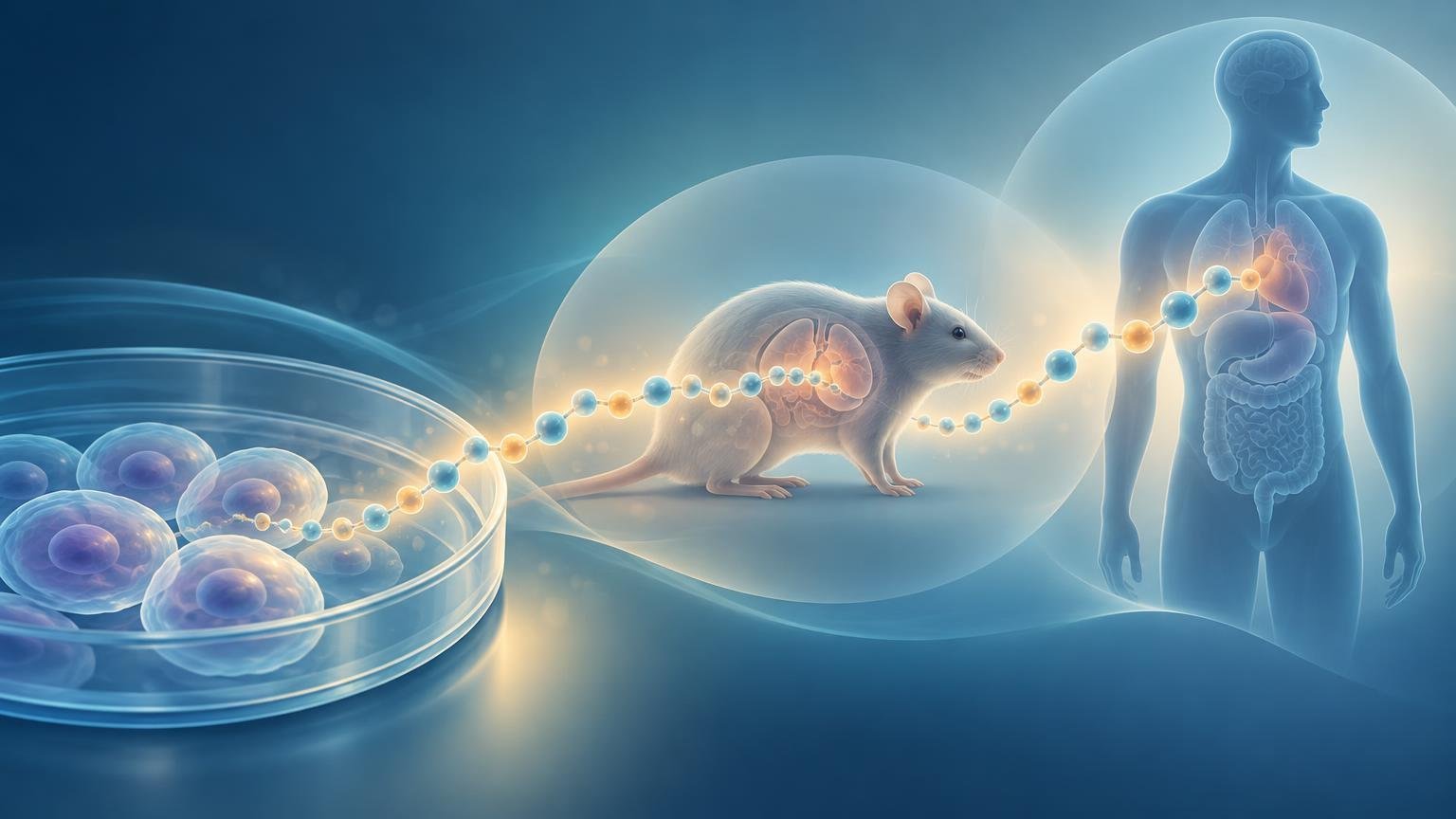
TLDR: In preclinical vs clinical research biotechnology, preclinical evidence comes from laboratory and model systems rather than human participants. It can establish biochemical activity, effects in cultured cells, exposure in animals, and specific safety findings. Clinical research studies people and is needed to characterize human safety, dose, pharmacology, and potential benefit. No earlier stage automatically predicts success at the next one.
The central question is not whether a biotechnology candidate has “evidence.” It is what kind of evidence it has. Activity in a purified-protein assay, an effect in cultured cells, altered tumor growth in a mouse model, and improved outcomes in a controlled human trial are all evidence—but they answer different questions. A useful interpretation starts by matching each claim to the experimental level that can support it.
Preclinical vs clinical research in biotechnology
Preclinical research is the broad body of nonhuman work used to understand a candidate before and sometimes during human development. It may include biochemical assays, cultured cells, tissue samples, organoids, computer-assisted models, and animal studies. It is therefore not synonymous with animal testing. The National Center for Advancing Translational Sciences presents translation as a spectrum that includes basic research, preclinical research, clinical research, implementation, and public health rather than a single jump from animals to people. Explore the NCATS translational science spectrum.
Clinical research involves people. It includes more than interventional trials: observational studies and human mechanistic research also qualify. For biotechnology development, however, the main comparison is usually between nonclinical studies and clinical trials that prospectively evaluate an intervention in human participants.
| Evidence level | Primary question | What it can add | What it does not establish alone |
|---|---|---|---|
| Biochemical or biophysical assay | Does the candidate interact with or alter a defined molecular system? | Binding, inhibition, catalysis, stability, or another assay-specific property | Cellular uptake, organism-level exposure, human safety, or clinical benefit |
| Cell-based study | Does an effect occur in a cellular model? | Internalization, localization, target engagement, signaling, viability, or another measured phenotype | Useful exposure in an organism or benefit in patients |
| In vivo nonclinical study | What happens in an intact nonhuman organism? | Exposure, biodistribution, pharmacology, tolerability, and toxicology in the tested model | Human safety or effectiveness |
| Human clinical study | What happens in people under a defined protocol? | Human safety, pharmacokinetics, pharmacodynamics, dose response, and potentially clinical outcomes | Universal benefit outside the studied population and conditions |
| Regulatory review | Does the submitted evidence support a defined regulatory decision? | An agency decision based on the total application, including quality and labeling information | An end to uncertainty or the need for ongoing safety monitoring |
The evidence ladder begins below the level of a whole cell
A biochemical assay deliberately simplifies biology. Researchers might measure whether a peptide binds a protein, whether an antibody blocks a receptor-ligand interaction, or whether an enzyme inhibitor reduces catalytic activity. This reduction is useful because it can connect a molecule to a proposed target under controlled conditions.
The limitation is equally important: a purified system removes membranes, metabolism, intracellular trafficking, immune responses, tissue barriers, and many competing interactions. A strong binding result may justify a mechanistic hypothesis, but it does not show that enough intact candidate reaches the target in a living cell. Even target affinity and biochemical potency are different from organism-level pharmacology.
For delivery technologies, the distinction becomes especially sharp. A peptide-cargo construct may retain activity in a cell-free assay while failing to cross a membrane. Conversely, a fluorescent signal associated with cells may reflect plasma-membrane binding or endosomal trapping rather than cytosolic availability. Methods that distinguish cell-surface binding from true internalization are therefore essential.
Cell culture adds biology—but not a patient
Cell-based studies introduce membranes, intracellular compartments, signaling networks, metabolism, and context-dependent phenotypes. Depending on the design, they can test uptake, localization, target engagement, pathway modulation, gene expression, proliferation, or cell death. They are often the first opportunity to ask whether biochemical activity survives contact with a more complex biological system.
Interpretation depends on what the experiment actually measures. Fluorescence microscopy may show localization but can be affected by extracellular signal, fixation, fluorophore behavior, and limited resolution. A viability assay may detect reduced metabolic activity without distinguishing growth arrest from cell death. A change in a downstream reporter can support pathway modulation but may not demonstrate direct engagement of the proposed target.
Productive intracellular delivery requires more than association with a cell. A delivery study may need to separate surface binding, internalization, endosomal localization, endosomal escape, cytosolic availability, target engagement, and functional effect. Appropriate controls can include untreated cells, vehicle and cargo-only controls, a validated positive control, toxicity measurements, concentration and time courses, and an orthogonal method that does not depend on the same detection artifact. The same reasoning applies to functional studies of cell-penetrating peptide–protein conjugates.
Cell type also matters. Receptor abundance, membrane composition, endocytic activity, protease expression, and pathway state can all change the observed response. Activity in one engineered cell line is evidence for that experimental system—not proof of activity across tissues, disease subtypes, or people.
What in vivo nonclinical studies add
An intact organism adds circulation, tissue distribution, clearance, metabolism, immune interactions, and organ-level toxicity. These studies can examine whether a candidate reaches relevant tissues, how exposure changes over time, whether a pharmacodynamic response accompanies exposure, and which adverse findings should influence clinical monitoring.
This is where pharmacokinetics and pharmacodynamics become especially useful. Pharmacokinetics describes what the organism does to the candidate, including absorption, distribution, metabolism, and elimination. Pharmacodynamics describes what the candidate does to the biological system. Connecting exposure to a target-related response is more informative than reporting either measurement alone.
Animal models can also expose a gap between cell penetration and tissue delivery. A construct that efficiently enters cultured cells may be degraded, cleared rapidly, sequestered in an unintended organ, or unable to cross a tissue barrier. That is why tissue selectivity and cell penetration are different problems.
Even well-designed animal work remains model-specific. Species can differ in target sequence, receptor distribution, immune recognition, metabolism, and disease biology. An animal result may support biological plausibility and inform further testing, but it cannot prove that the candidate will be safe or beneficial in humans.
Why relevant species matter for biotechnology products
Species selection can be particularly difficult for proteins, antibodies, peptides, and other biotechnology-derived candidates. A species is informative only if the candidate has biologically relevant activity in that model. If the target is absent, structurally different, or distributed differently, a conventional toxicity study may not reproduce the pharmacology expected in people.
ICH guidance for biotechnology-derived pharmaceuticals treats nonclinical planning as science-based and case-specific. Relevant model selection can help characterize pharmacology, potential toxicities, an initial clinical-dose rationale, and suitable monitoring, but the appropriate program depends on the product and its biology.
Immunogenicity adds another complication. A human protein or engineered biologic may provoke an immune response in an animal because it is recognized as foreign. That response can change exposure or produce findings that do not map cleanly onto human risk. Such results still require analysis, but their relevance depends on mechanism and context.
The transition to human research and the role of an IND
Before specified clinical investigations of a drug can begin in the United States, a sponsor uses an Investigational New Drug application, or IND, to provide information supporting the proposed study. The package includes pharmacology and toxicology information intended to support a conclusion that the planned investigation is reasonably safe to initiate, along with clinical protocols and manufacturing information. Read the FDA overview of IND pharmacology and toxicology information.
“IND-enabling” is commonly used for studies and documentation assembled to support an IND, but it is not a single universal experiment. The necessary work depends on the candidate, proposed population, route, dose, duration, and existing knowledge.
An IND is not marketing approval. It also does not mean that FDA has determined the candidate is effective, generally safe for clinical use, or suitable for use outside the authorized investigation. It permits a regulated clinical-development step; it does not settle the product’s benefit-risk profile.
What clinical trials add at each phase
Clinical studies replace predictions about people with direct human observations, but their conclusions remain bounded by design. Population, comparator, randomization, blinding, endpoint, duration, sample size, adherence, and missing data all affect what a trial can establish.
- Phase 1 chiefly examines safety, tolerability, dose, and human pharmacology under close monitoring. It may also explore pharmacokinetics and pharmacodynamic markers. Early studies are not always conducted in healthy volunteers; the appropriate population depends on the candidate and disease context.
- Phase 2 commonly investigates preliminary effectiveness in the target population while adding safety and dose information. Positive results can support further study, but small or exploratory trials may not provide a definitive estimate of benefit.
- Phase 3 generally evaluates effectiveness and safety in larger, more confirmatory studies designed to support a benefit-risk assessment for a proposed use. The exact program varies by product and regulatory pathway.
FDA uses these phase descriptions as broad development categories. ICH E8(R1) also emphasizes that clinical development may be stepwise without being rigid: studies can overlap, and adaptive or otherwise innovative designs may combine questions traditionally assigned to separate phases. A phase label is therefore informative, but the protocol reveals what was actually tested.
Human target engagement or a biomarker response is valuable, but it is not automatically a meaningful clinical benefit. A pharmacodynamic marker can show that a biological system changed after treatment. Whether that change improves how participants feel, function, or survive requires endpoints and a study design capable of answering that question.
Modern preclinical models and new approach methodologies
Organoids, microphysiological systems such as organs-on-chips, human-cell-based assays, and computational models can make some preclinical questions more human-relevant. They may help compare candidates, investigate mechanisms, model specific tissue responses, or identify hazards that a simpler assay would miss.
FDA describes these approaches as new approach methodologies that may improve predictive relevance and reduce or replace animal use where scientifically appropriate. That does not mean every method is validated for every purpose or that all development programs can currently be animal-free. The right question is not whether a model is modern, but whether it is sufficiently characterized and fit for the decision being made.
Model quality depends on the endpoint. An organoid may reproduce selected tissue architecture while lacking systemic circulation or a complete immune system. A computational model is constrained by its assumptions and input data. An animal model integrates whole-organism physiology but introduces species differences. Combining complementary systems can be more informative than asking one model to answer every question.
Regulatory review is another evidence step, not a laboratory experiment
For a marketing application, FDA evaluates the submitted nonclinical and clinical evidence together with manufacturing, product-quality, and labeling information. This integrated review is different from observing an effect in a study: it asks whether the complete application supports authorization for a specific product, population, use, and labeling framework.
Approval does not imply that every uncertainty has disappeared. Clinical trials study defined populations over limited periods, and uncommon or delayed adverse events may become clearer only with wider use. Post-market pharmacovigilance, additional studies, inspections, and regulatory actions therefore remain distinct parts of the evidence lifecycle.
How to read biotechnology development claims
Development labels are useful shorthand only when translated into the evidence they represent. The following interpretations keep the claim proportional to the stage:
- “Active in a biochemical assay” means the candidate changed a defined assay readout. Ask whether the assay demonstrates binding, inhibition, catalysis, or another specific mechanism.
- “Active in cells” means an effect was measured in a cellular system. Ask which cells, concentration, exposure time, endpoint, controls, and toxicity measurements were used.
- “Preclinical-stage” means the program has not yet established safety and benefit through human clinical development. Ask which nonclinical studies are complete and whether the result is biochemical, cellular, ex vivo, computational, or in vivo.
- “Effective in an animal model” describes the tested model, dose, route, and endpoint. It should not be rewritten as “works in humans.”
- “IND submitted” reports an administrative development event, not permission to market the candidate. Ask whether the clinical study has begun and what protocol is being evaluated.
- “In Phase 1” means human testing is underway at an early stage. It does not imply demonstrated clinical benefit.
- “Met the primary endpoint” is interpretable only with the endpoint definition, comparator, effect size, uncertainty, analysis plan, and safety findings.
- “Approved” refers to a regulatory decision for a defined product and use. It should not be generalized to different doses, populations, combinations, or unapproved uses.
The strongest conclusion follows the experimental level
A sound biotechnology evidence assessment moves one question at a time. Biochemical studies can establish molecular activity. Cell experiments can show whether that activity persists in a cellular context. In vivo nonclinical studies add exposure, distribution, integrated pharmacology, and model-specific safety information. Clinical studies are required to determine what happens in people. Regulatory review then considers the larger evidence package for a defined decision.
The practical next step is to replace every broad claim with three questions: What system was studied? What endpoint was measured? What conclusion does that design support? This approach does not dismiss promising preclinical findings. It places them where they belong—as evidence supporting the next experiment, rather than proof of a human outcome.
References
- Translational Science Spectrum | National Center for Advancing Translational Sciences
- Step 2: Preclinical Research | FDA
- Clinical & Translational Research – Overview | Research
- Step 3: Clinical Research | FDA
- IND Applications for Clinical Investigations: Pharmacology and Toxicology (PT) Information | FDA
- TESTING FOR CARCINOGENICITY OF PHARMACEUTICALS
- INTERNATIONAL
- www.fda.gov
- Drug Development and Review Definitions | FDA
- Step 4: FDA Drug Review | FDA
- database.ich.org
- www.fda.gov
- www.fda.gov
- www.fda.gov