TLDR
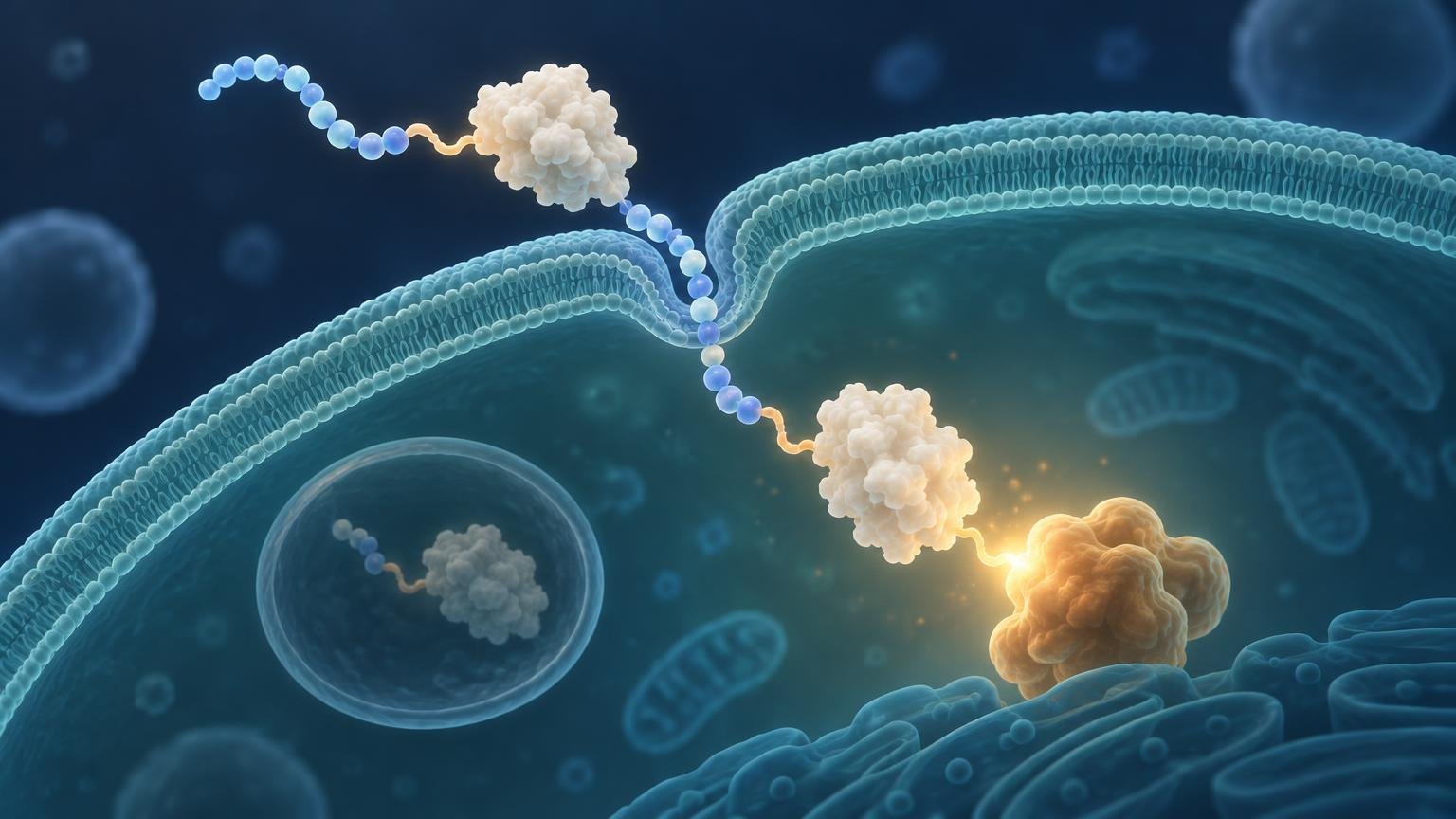
A cell penetrating peptide protein conjugate combines a protein cargo with a cell-penetrating peptide, or CPP, to promote cellular entry. The central design question is not simply whether cells take up the construct. Researchers need to determine whether intact cargo reaches the required intracellular compartment, retains its biochemical activity, and produces a cargo-specific effect without unacceptable membrane damage or toxicity. Linker chemistry, attachment site, conjugation stoichiometry, cargo size, charge, folding, and endosomal escape can all change the result.
The phrase cell penetrating peptide protein conjugate also covers several materially different architectures. A CPP may be chemically attached to a purified protein, genetically fused to it, connected through a reversible adaptor, or supplied separately as an uptake-enhancing additive. These formats should not be treated as interchangeable. The most informative development program compares architectures and follows delivery through successive stages: cell association, internalization, endosomal trafficking, cytosolic access, target engagement, and functional response.
What counts as a CPP–protein conjugate?
In the narrowest sense, a CPP–protein conjugate is a covalent construct in which a CPP is chemically linked to a protein. In broader usage, the term may include recombinant fusion proteins and reversible assemblies. CPPs have been investigated as vectors for peptide and protein cargo using both covalent and non-covalent approaches, but performance varies with the CPP, cargo, cell model, and experimental conditions. The review of CPP delivery for peptide and protein cargos provides a useful overview of these architecture-dependent challenges.
| Architecture | How CPP and protein are connected | Main advantage | Central limitation |
|---|---|---|---|
| Recombinant fusion | CPP sequence is encoded at the protein’s N-terminus, C-terminus, or an internal permissive site | Defined sequence and usually fixed stoichiometry | Fusion may alter expression, folding, localization, or activity |
| Direct chemical conjugate | Reactive groups on the CPP and purified protein form a covalent linkage | Can modify an existing protein without re-expression | Non-site-selective chemistry may create a heterogeneous product |
| Cleavable conjugate | CPP and protein are joined by a reducible, protease-sensitive, or otherwise labile linker | Allows intracellular separation of CPP and cargo | Cleavage may be premature, incomplete, or occur in the wrong compartment |
| Affinity adaptor | CPP-bearing adaptor binds an engineered feature on the cargo | Potentially reversible and modular | Additional components complicate affinity, stability, and trafficking |
| Non-covalent complex | Electrostatic or other reversible interactions assemble CPP with cargo | Simple screening and formulation | Complex composition and stability may vary with the biological environment |
| CPP additive | CPP-derived material is co-administered rather than permanently attached | Tests whether uptake or escape can be enhanced without modifying cargo | CPP and cargo may separate before reaching the same cell or compartment |
For example, a reported TAT–calmodulin system used a CPP-bearing adaptor that reversibly bound engineered protein cargos. It was designed to investigate intracellular delivery and endosomal escape, but it was not a permanently linked CPP–protein conjugate. Cell-surface-reactive CPP additives have also been studied for delivering proteins, nanobodies, and full-length antibodies, providing another comparator to direct conjugation.
Choose the architecture before choosing the CPP
CPP selection is often treated as the first decision, but the cargo’s biological requirements should come first. A cytosolic enzyme, nuclear transcription factor, and endosomal protein do not need the same itinerary. Define where the cargo must arrive, whether its termini must remain unobstructed, whether it needs to bind partners, and whether the CPP must be removed before the protein can function.
Recombinant fusion is attractive when a genetically defined product and fixed CPP-to-protein ratio are important. It can also simplify site selection: the CPP can be placed at a terminus or in a validated permissive region. Nevertheless, adding a short, highly charged sequence may change protein expression, purification, folding, oligomerization, or susceptibility to proteolysis. Activity of the purified fusion should therefore be compared with that of the unmodified protein before cellular delivery is interpreted.
Chemical conjugation is useful when the protein is already available or when a synthetic linker is needed. Random modification of lysines or cysteines, however, can produce positional and stoichiometric mixtures. If the modified residue lies near an active site, binding interface, localization sequence, or structural disulfide, delivery may improve while function declines. Site-selective conjugation generally makes the relationship between molecular structure and biological effect easier to interpret.
Computational modeling can help identify accessible attachment sites and anticipate structural interference. A glucarpidase model study, for example, examined CPP selection and attachment orientation for covalent constructs. Such predictions are design tools rather than evidence that the resulting protein will be delivered or remain active in cells.
How linker chemistry changes the experiment
A non-cleavable linker keeps the CPP attached throughout trafficking and target engagement. This may be acceptable when the protein tolerates the modification and the CPP does not interfere with activity. It also makes molecular accounting comparatively straightforward because fluorescence and cargo remain associated, assuming the construct itself is stable.
A cleavable linker is more appropriate when the CPP is expected to obstruct folding, binding, catalysis, or intracellular localization. Disulfides are commonly considered because reducing environments can promote cleavage after cellular entry. But “reducible” does not mean “cytosol-specific.” The construct may encounter thiols before internalization, remain trapped in a compartment where cleavage is inefficient, or be degraded before productive release. A 2025 cellular study reported disulfide-linked cyclic-CPP conjugates with ubiquitin and UbcH7 and assessed delivery using fluorescence imaging. It supports the feasibility of that particular construct strategy, not a general conclusion that disulfides solve protein delivery.
Protease-sensitive linkers introduce a different dependency: the relevant enzyme must be present, active, and accessible in the intended compartment. Cleavage kinetics should therefore be measured in defined biochemical conditions and, where possible, inside the biological model. For any releasable design, researchers should separately quantify intact conjugate, released cargo, and degradation products.
Cargo size matters, but it is not a universal cutoff
Larger proteins can increase steric burden, expose more charged and hydrophobic surface, and create additional opportunities for aggregation or nonspecific interactions. Yet molecular mass alone does not predict delivery. Shape, oligomeric state, net charge, local charge distribution, conformational stability, linker geometry, and the number of attached CPPs all influence the construct’s behavior. The practical question is how the complete assembly behaves, not whether the protein falls below a nominal size limit. A deeper discussion appears in how cargo size changes CPP delivery.
Cargo identity can also change the uptake route. A CPP that appears effective with a small fluorescent peptide may perform differently when attached to a folded enzyme or antibody fragment. Increasing CPP valency can strengthen cell-surface association, but it may also increase aggregation, membrane disruption, endosomal sequestration, or clearance in an animal model. Each protein cargo therefore requires empirical characterization.
Why uptake is not proof of cytosolic delivery
A strong fluorescence signal can arise from material bound to the plasma membrane, internalized into endosomes, released fluorophore, or degraded fluorescent fragments. Even convincing punctate intracellular fluorescence often indicates vesicular localization rather than cytosolic availability. Reviews of CPP delivery consistently identify endosomal sequestration as a major barrier and warn against equating cell-associated signal with productive delivery.
The stages should be evaluated separately: surface association, internalization, endosomal localization, endosomal escape, cytosolic availability, organelle localization, target engagement, and functional effect. Methods for distinguishing the first stages are discussed in cell-surface binding versus true internalization in CPP experiments.
Endosomal escape is a design problem in its own right. Branched TAT-derived constructs have been investigated as endosomolytic reagents both when connected with cargo and when co-incubated in trans. This supports testing escape-enhancing components independently from initial uptake. A construct can internalize efficiently yet remain functionally inactive because only a small fraction reaches the cytosol. Conversely, a low total intracellular signal can still be biologically meaningful if the delivered fraction reaches a sensitive target.
A functional evaluation workflow
No single assay establishes successful protein delivery. A useful workflow builds a chain of evidence, beginning with molecular characterization and ending with a cargo-specific intracellular response.
- Characterize the construct. Confirm protein identity, conjugation site where possible, CPP-to-protein ratio, intact mass, purity, aggregation state, and stability. For heterogeneous conjugation, report the distribution rather than only an average labeling ratio.
- Test cargo function before cellular experiments. Compare the conjugate with unmodified protein in an appropriate activity or binding assay. This separates delivery failure from damage caused during conjugation, purification, or storage.
- Measure surface association and internalization separately. Include untreated cells, unconjugated protein, CPP alone, and a relevant non-penetrating or sequence-scrambled control. Washing, surface stripping, or extracellular fluorescence quenching can help, but each method requires validation for the construct.
- Assess intracellular localization. Use imaging with suitable organelle markers, optical sectioning, and quantitative colocalization where appropriate. Confirm that the label remains associated with intact cargo; a stable fluorophore can outlive the protein it originally marked.
- Demonstrate cytosolic access with an orthogonal method. Options include compartment-sensitive reporters, cytosolic enzyme complementation, carefully controlled fractionation, or a cytosol-dependent cargo effect. Each has artifacts, so agreement between methods is more persuasive than one positive readout.
- Measure target engagement or cargo-specific function. Select an endpoint that depends on the intact protein acting in the required compartment. A biochemical interaction, reporter response, rescue phenotype, or loss of function after target disruption can be more informative than total fluorescence.
- Evaluate membrane damage and general toxicity. Measure viability alongside membrane integrity and inspect whether the CPP causes broad leakage. Apparent delivery accompanied by indiscriminate permeabilization is mechanistically different from controlled intracellular transport.
- Test concentration, time, and cell-type dependence. CPP behavior can change sharply with exposure conditions. Include multiple concentrations and time points rather than selecting only the condition with the brightest signal.
- Advance to in vivo work only when the question requires it. Distribution, stability, tissue access, immune interactions, clearance, and target-tissue selectivity introduce barriers not represented by a cultured-cell uptake assay. Cell penetration and tissue selectivity are different biological problems.
Controls that make the mechanism interpretable
The essential negative control is the same protein without the CPP, handled and labeled in the same way. CPP alone tests whether the carrier produces the measured phenotype independently of cargo. A cargo-inactive mutant can show whether the cellular response requires protein activity, while a non-cleavable counterpart can test whether release is necessary. If the proposed mechanism depends on a receptor, trafficking route, or intracellular target, perturbing that component can add causal evidence.
Label placement also matters. A dye attached to the CPP may separate from a cleavable protein cargo and report the wrong molecular species. Dual labeling can help track separation, but it adds complexity and may alter the construct. Whenever possible, combine localization with direct analysis of intact or released protein and a functional readout.
Match conclusions to the evidence level
| Evidence level | What it can support | What it does not establish |
|---|---|---|
| Biochemical characterization | Construct identity, integrity, cleavage, binding, or retained activity under tested conditions | Cellular uptake or delivery |
| Cell association | Contact with cells or total cell-associated signal | True internalization |
| Internalization | Material has crossed the plasma-membrane boundary into the cell | Cytosolic availability or intact cargo |
| Cytosolic-access assay | Access to a cytosol-dependent reporter or compartment-sensitive readout | Correct target engagement in every cell |
| Cargo-specific cellular function | A cellular effect consistent with active cargo in the tested model | In vivo distribution, safety, or efficacy |
| Animal study | Exposure and biological effects in a defined species and model | Human efficacy or clinical safety |
| Human study | Findings in the studied population, regimen, and endpoints | Universal performance across cargos or CPP architectures |
This evidence ladder prevents a common overstatement: moving directly from microscopy to claims of functional protein delivery. The strongest cellular case combines construct integrity, cytosolic-access evidence, retained cargo activity, mechanistic controls, and acceptable membrane integrity. Animal or human conclusions require their own evidence and cannot be inferred from cultured cells.
A practical design decision
Start with recombinant fusion when fixed composition and genetic production are compatible with the protein. Consider site-selective chemical conjugation when the cargo is already produced, an engineered release mechanism is needed, or fusion expression is impractical. Add a cleavable linker when persistent CPP attachment is likely to obstruct function—but only if cleavage can be measured in the relevant compartment. Include adaptor or additive formats as comparators when permanent protein modification is undesirable.
There is no universal best CPP, linker, orientation, or stoichiometry for protein delivery. A defensible choice is the architecture that preserves cargo integrity, reaches the required compartment, produces a cargo-dependent response, and does so without relying on nonspecific membrane damage. The next experimental step should therefore be selected by the weakest link in the evidence chain—not automatically by the construct with the highest total fluorescence.
References
- Applications and Challenges for Use of Cell-Penetrating Peptides as Delivery Vectors for Peptide and Protein Cargos – PMC
- Cell-Penetrating Peptides: Possibilities and Challenges for Drug Delivery in Vitro and in Vivo – PMC
- Novel cell-penetrating peptide-adaptors effect intracellular delivery and endosomal escape of protein cargos – PubMed
- Cellular uptake of large biomolecules enabled by cell-surface-reactive cell-penetrating peptide additives – PubMed
- Considerations on the Rational Design of Covalently Conjugated Cell-Penetrating Peptides (CPPs) for Intracellular Delivery of Proteins: A Guide to CPP Selection Using Glucarpidase as the Model Cargo Molecule – PubMed
- Efficient Synthesis of Cleavable Cell-Penetrating Peptide-Cargo Conjugate via Low-Equivalent of Cell-Penetrating Peptide Activated by 2,2'-Dithiodipyridine.
- Generation of endosomolytic reagents by branching of cell-penetrating peptides: tools for the delivery of bioactive compounds to live cells in cis or trans – PubMed