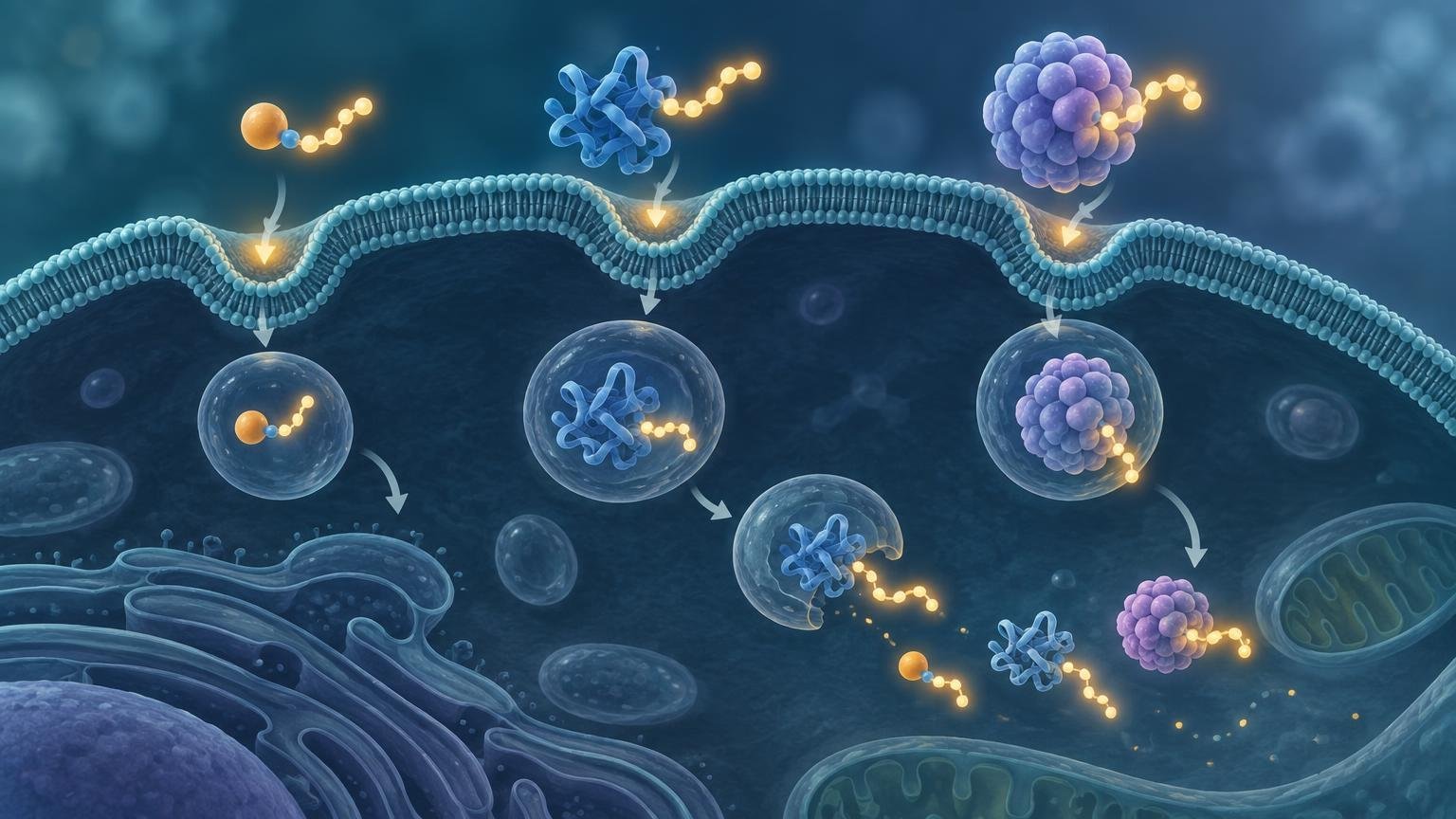
TLDR: There is no universal cell penetrating peptide cargo size cutoff expressed in kilodaltons, amino acids, or nanometers. Small cargos are not automatically delivered efficiently, and large cargos are not categorically excluded. Practical performance depends on the complete CPP–cargo construct or complex: its charge, shape, stability, aggregation state, uptake route, intracellular release, localization, and ability to retain biological activity.
Cargo size matters because adding a molecule to a cell-penetrating peptide can change the behavior of both components. The more useful question is therefore not “How much weight can a CPP carry?” but “Can this specific formulation cross each barrier and release functional cargo in the required intracellular compartment?” That distinction prevents cellular fluorescence or total uptake from being mistaken for productive delivery.
Why cell penetrating peptide cargo size has no single limit
Size is not one interchangeable measurement. Molecular mass may be useful for a small molecule or peptide, while amino-acid length says little about whether a protein is compact, elongated, folded, or aggregated. Nucleic acids introduce contour length, charge, secondary structure, and complex size. Nanoparticles are usually described by a physical or hydrodynamic diameter, but their behavior also depends on the material, surface coating, particle distribution, and biomolecular corona.
CPP internalization is likewise context-dependent. CPP sequence, cargo identity, conjugation method, concentration, cell type, and experimental conditions can alter the observed uptake route. Endocytosis is common, but multiple pathways and, under some conditions, proposed direct-translocation mechanisms have been reported. A mechanism observed for one CPP–cargo system should not automatically be assigned to another.
A useful delivery model separates the process into stages: cell-surface association, internalization, endosomal trafficking, endosomal escape, release from the carrier, arrival in the cytosol or nucleus, target engagement, and functional activity. Failure at any stage can dominate the result. Researchers evaluating the first two stages can use the controls described in this guide to cell-surface binding and true internalization.
How the constraints differ by cargo class
| Cargo class | Useful size description | Common practical constraint | Most informative endpoint |
|---|---|---|---|
| Small molecules | Molecular mass plus structure and physicochemical properties | Conjugation can alter solubility, distribution, target affinity, or release | Intracellular target engagement or a specific functional response |
| Peptides | Residue count, molecular mass, conformation, and conjugate size | Proteolysis, altered CPP behavior, vesicular retention, or incomplete linker cleavage | Compartment-specific availability and retained peptide function |
| Proteins | Molecular mass, folded dimensions, oligomeric state, and aggregation | Endosomal sequestration, unfolding, degradation, or loss of activity | Cytosolic exposure combined with an activity assay |
| Nucleic acids | Length, molecular mass, charge, structure, and complex dimensions | Heterogeneous complex formation, endosomal trapping, degradation, or poor release | Sequence-specific activity rather than uptake alone |
| Nanoparticles | Core size, hydrodynamic diameter, size distribution, and aggregation state | Surface chemistry, CPP density, protein corona, trafficking, and particle retention | Particle localization plus release and function of any carried payload |
The table highlights a general pattern: as cargo becomes larger or more structurally complex, mass alone becomes less informative. The relevant delivery unit may be a covalent conjugate, a noncovalent assembly, or a CPP-functionalized particle. Its effective dimensions and surface properties can differ substantially from those of the isolated cargo.
Small molecules: chemistry can matter more than mass
For a small molecule, the CPP may contribute more mass and charge than the cargo itself. Covalent attachment can improve association with cells while simultaneously changing aqueous solubility, membrane interactions, protein binding, or access to the intended target. A linker may therefore need to remain stable outside the cell but release the cargo after internalization. If it does not cleave, the experiment is testing the CPP–drug conjugate rather than the original small molecule.
Total intracellular signal is not enough to resolve these questions. A labeled conjugate can accumulate in vesicles without producing a useful free concentration at a cytosolic target. The preferred endpoint is target engagement or a mechanistically specific cellular response, supported by controls for the unconjugated cargo, CPP alone, linker chemistry, toxicity, and fluorophore behavior.
Peptide cargos: a construct-specific size effect
Peptide cargo can be incorporated into a continuous fusion sequence or joined through a chemical linker. Relevant variables include charge distribution, secondary structure, protease sensitivity, and whether the cargo changes the CPP’s interaction with membranes or uptake machinery. A short cargo can still interfere with delivery if it promotes aggregation, masks key CPP residues, or binds extracellular material.
The often-cited size distinction in TAT research should be interpreted narrowly. A 2006 live-cell study of TAT-containing peptides and proteins reported rapid entry and more diffuse intracellular distribution for tested peptide cargos below 50 amino acids, whereas the tested globular protein cargos above 50 amino acids were observed mainly in cytoplasmic vesicles. This was a cargo-dependent result for particular constructs and conditions, not a universal 50-residue limit for all CPPs.
Proteins and large biomolecules: entry is only the first barrier
Proteins introduce folded dimensions, surface charge patches, oligomerization, and structural fragility. The attached CPP can affect solubility or activity, while endosomal conditions and proteases can damage the cargo before it reaches the cytosol. Even intact internalized protein may remain confined to vesicles and never contact a cytosolic target.
Cell-based research has reported uptake of proteins, enzymes, nanobodies, and full-length immunoglobulin G using cell-surface-reactive CPP additives. These findings show that large biomolecule uptake is experimentally possible; they do not establish that every macromolecule will achieve efficient cytosolic exposure or preserve function in every cell type. Quantitative work with CPP–model protein constructs also shows why uptake and endosomal escape must be measured separately: increased internalization does not necessarily produce a proportional increase in cytosolic delivery.
A convincing protein-delivery study should combine evidence of intact cargo with a compartment-sensitive measurement and an activity assay. Imaging can show localization, but biochemical fractionation, split-reporter systems, enzyme complementation, or another validated cytosolic assay may answer a different and more relevant question. Each method needs controls for membrane-bound material, endosomal leakage during sample preparation, and nonspecific toxicity.
Nucleic acids: measure the complex, not just the sequence
Nucleic-acid cargos are highly charged and may form noncovalent assemblies with cationic CPPs. In that setting, oligonucleotide length is only one input. CPP-to-cargo ratio, charge balance, salt conditions, secondary structure, particle heterogeneity, nuclease exposure, and aggregation can determine the dimensions and behavior of the resulting complex.
Covalent conjugation offers defined stoichiometry but can complicate synthesis and intracellular release. Noncovalent complexation is often more adaptable to different cargos, yet it may produce a distribution of assemblies rather than one molecular species. The choice should follow the experimental need: a defined molecular construct favors covalent attachment, while formulation screening or multivalent condensation may favor a noncovalent approach. Neither format removes the need to characterize stability and release.
Functional assays are especially valuable here. In a reported CPP–peptide nucleic acid system, uptake depended on endocytosis, while splice-correction activity differed substantially among the tested CPP conjugates. The result illustrates that internalization and functional access to a nucleic-acid target are separate outcomes. Appropriate endpoints might include sequence-specific splice correction, transcript reduction, editing, or reporter expression, depending on the cargo and research question.
Nanoparticles: diameter is important but not sufficient
For a CPP-functionalized nanoparticle, cargo size may refer to the core, the coated particle, or the complete formulation after exposure to biological fluid. Hydrodynamic diameter generally captures the particle plus associated surface layers in suspension, making it more relevant than core diameter alone for many transport questions. Polydispersity and aggregation also matter because a nominal average can conceal a substantial population of larger assemblies.
A study of CPP-conjugated PEGylated gold nanoparticles examined particles spanning approximately 2.4 to 89 nanometers in COS-1 cells and reported that particle size and CPP use affected uptake and intracellular fate. That range should not be treated as a universal delivery window: the result applies to the tested gold-particle formulation, surface chemistry, CPP arrangement, and cell model. CPP density, particle composition, serum proteins, aggregation, and exposure conditions can all change the biological identity of another formulation.
Why total uptake does not prove productive delivery
Many apparently conflicting size results become easier to understand when the measured endpoint is identified. Flow cytometry may quantify cell-associated fluorescence but cannot, by itself, separate surface binding from vesicular or cytosolic signal. Conventional microscopy can show punctate versus diffuse patterns, yet limited resolution, fixation artifacts, and fluorophore cleavage can complicate interpretation. Bulk lysate measurements lose spatial information altogether.
The strongest design uses complementary methods. Surface quenching or protease treatment can help remove extracellular signal. Live-cell imaging can reduce fixation artifacts. Colocalization with endosomal markers can support, but not alone prove, vesicular localization. A cytosolic-access assay addresses escape more directly, while a cargo-specific functional readout tests whether delivery was biologically productive. Viability and membrane-integrity controls are needed because nonspecific membrane damage can mimic efficient entry.
A reporting checklist for cargo-size experiments
- Identify the CPP sequence, modifications, conjugation site, and CPP density or stoichiometry.
- Report the cargo’s molecular mass and the size measure appropriate to its class: residue or nucleotide length, folded dimensions, hydrodynamic diameter, or particle distribution.
- Characterize the complete conjugate or complex rather than reporting only the isolated components.
- For particulate systems, report size distribution, aggregation state, and zeta potential where relevant.
- Distinguish free CPP and free cargo from the assembled delivery system.
- State the cell model, concentration, exposure time, medium, serum conditions, and temperature.
- Use controls that separate cell-surface association from true internalization.
- Assess endosomal localization and cytosolic or nuclear access with methods appropriate to the intended destination.
- Include a cargo-specific functional assay and controls for toxicity or membrane disruption.
- Report whether activity requires intracellular release and whether the released cargo retains molecular integrity.
What changes beyond cultured cells
A construct that enters cultured cells still faces additional barriers in tissue or animal studies. Serum binding, proteolysis, immune clearance, vascular transport, extracellular matrix, tissue distribution, and uptake by unintended cell populations can all precede intracellular delivery. Tissue selectivity is therefore a separate problem from cell penetration, as explained in this comparison of tissue targeting and cellular entry.
Disease-model activity should be labeled by evidence level. A biochemical result establishes activity in a defined molecular system; a cell-based result adds cellular context; and an animal result adds organism-level distribution and physiology. None alone establishes safety or effectiveness in humans. The delivery endpoint should remain explicit at every stage.
Conclusion: evaluate the whole delivery system
The practical limit on CPP cargo delivery is not one molecular weight, peptide length, or nanoparticle diameter. It emerges from the complete construct, the biological environment, and the intracellular destination. As cargo becomes larger or more complex, the dominant challenge commonly shifts from association and uptake toward trafficking, escape, release, structural integrity, and retained function.
The next step in evaluating any CPP system is to define the required destination and functional endpoint before optimizing size. Then characterize the full conjugate or complex, distinguish surface binding from internalization, measure cytosolic or nuclear access, and confirm cargo-specific activity. That sequence produces a more informative answer than searching for a universal cargo-size cutoff.
References
- Internalization mechanisms of cell-penetrating peptides – PMC
- Different mechanisms for cellular internalization of the HIV‐1 Tat‐derived cell penetrating peptide and recombinant proteins fused to Tat – Silhol – 2002 – European Journal of Biochemistry – Wiley Online Library
- Cargo‐dependent mode of uptake and bioavailability of TAT‐containing proteins and peptides in living cells – Tünnemann – 2006 – The FASEB Journal – Wiley Online Library
- Cellular uptake of large biomolecules enabled by cell-surface-reactive cell-penetrating peptide additives – PubMed
- Unravelling cytosolic delivery of cell penetrating peptides with a quantitative endosomal escape assay.
- Distinct uptake routes of cell-penetrating peptide conjugates – PubMed
- Cellular uptake and fate of PEGylated gold nanoparticles is dependent on both cell-penetration peptides and particle size – PubMed