
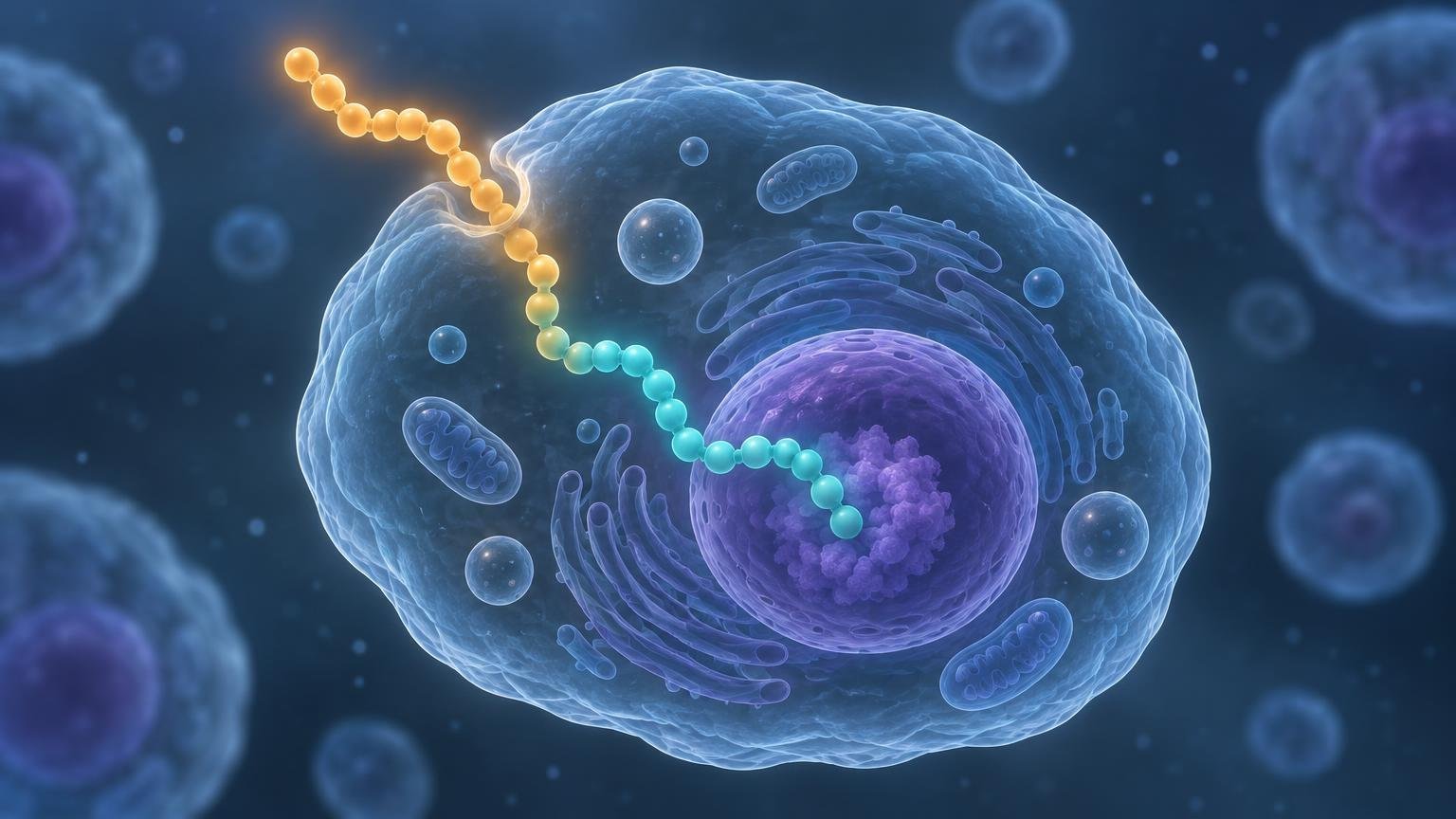
CB5005M and CB5005N were designed as complementary parts of one 21-residue peptide, not as interchangeable versions of the same molecule. CB5005M is the hydrophobic, membrane-permeable segment. CB5005N is derived from the nuclear-localization sequence of the NF-κB p50 subunit and supplies the construct’s proposed NF-κB-interference function. The full sequence joins these roles as KLKLALALALAVQRKRQKLMP.
The comparison therefore is not a contest over which segment is “better.” It is a division of molecular labor: cellular entry first, followed by intracellular localization and pathway interference. That distinction is central to understanding both the design and the limits of the evidence.
CB5005M and CB5005N at a glance
| Feature | CB5005M | CB5005N |
|---|---|---|
| Canonical sequence | KLKLALALALA | VQRKRQKLMP |
| Position in CB5005 | N-terminal 11 residues | C-terminal 10 residues |
| Design origin | Hydrophobic membrane-permeable motif | NF-κB p50 nuclear-localization sequence |
| Intended role | Support cell-membrane passage and intracellular access | Support nuclear-localization-related behavior and interfere with NF-κB translocation |
| What it does not establish by itself | Productive cytosolic or nuclear delivery | Independent passage across the plasma membrane |
These labels describe functional regions within a composite peptide. They do not prove that either isolated segment will reproduce the behavior of full CB5005 in a given cell, formulation, or animal model. Construct architecture, concentration, cargo, cell type and assay method can all change apparent delivery behavior.
CB5005M supplies the membrane-permeable motif
CB5005M comprises the N-terminal sequence KLKLALALALA. Patent literature and later delivery studies describe this region as the membrane-permeable or cell-penetrating portion of CB5005. Its alternating hydrophobic residues and lysines give it physicochemical features associated with membrane interaction, while later work attributes the construct’s translocating behavior in part to this segment.
“Membrane permeable” still needs careful interpretation. A peptide may associate with the cell surface, enter through endocytosis or cross a membrane by another concentration- and context-dependent route. Detecting cell-associated fluorescence does not automatically show free peptide in the cytosol. Readers interested in that experimental distinction can compare direct translocation with endocytic uptake.
Controls reported in the patent record and foundational NF-κB peptide research found that deleting or mutating the membrane-permeable motif was associated with loss of activity in the tested systems. That supports the functional importance of the motif within the composite design, although it does not establish one universal uptake pathway or clinical activity.
CB5005N supplies the p50 NLS-derived segment
CB5005N is generally reported as VQRKRQKLMP. It was derived from the nuclear-localization sequence, or NLS, of the NF-κB p50 subunit. In the full construct, this segment is described as both nuclear-localization-related and responsible for the proposed interference with NF-κB nuclear translocation.
A nuclear-localization signal and a plasma-membrane-entry sequence solve different biological problems. Classical basic NLS motifs can be recognized by importin-α, while importin-β participates in transport through the nuclear pore and RanGTP contributes to cargo release in the nucleus. The review of classical nuclear-localization signals explains this import pathway in detail.
How the two segments support the proposed NF-κB mechanism
NF-κB complexes are commonly retained in the cytoplasm through association with IκB proteins. Following an appropriate stimulus, phosphorylation and degradation of IκB can permit NF-κB to move into the nucleus and regulate transcription. CB5005’s design was intended to interfere competitively with that nuclear-translocation step after the peptide entered the cell.
The foundational published NF-κB peptide study reported that a synthetic peptide combining a hydrophobic membrane-permeable motif with an NF-κB p50 NLS inhibited stimulated NF-κB nuclear translocation in cultured endothelial and monocytic cells. This supports the two-part design concept in those cell systems. It does not by itself demonstrate that every measured downstream effect results exclusively from direct competition at the nuclear-import machinery.
Mechanistically, several experimental levels remain separate. Uptake does not establish cytosolic availability; cytosolic availability does not establish nuclear localization; localization does not establish target engagement; and target engagement does not automatically establish a specific downstream phenotype. Nuclear and cytoplasmic fractionation can help test one part of this chain, provided that fraction purity and protein normalization are controlled. Our guide to nuclear versus cytoplasmic Western blots for NF-κB examines those controls.
Why sequence suffixes require care
The canonical CB5005 sequence ends with MP. Some later constructs add a terminal cysteine for conjugation, producing an MPC ending. One report labels VQRKRQKLMPC as CB5005N, but this can indicate a cysteine-bearing derivative used in conjugation chemistry rather than a revised canonical NLS-derived core. Naming alone is not enough to resolve the construct.
When comparing studies, inspect the complete sequence and formulation rather than relying only on the CB5005N label. Verify whether the material was the free segment, full CB5005, a cysteine-modified derivative or a peptide attached to a liposome or another cargo. These constructs answer different experimental questions.
What the preclinical record establishes
The disease-related literature largely evaluates full CB5005 or CB5005-functionalized delivery systems. A 2016 study reported uptake and nuclear localization in cultured cells, penetration into tumor spheroids, tissue fluorescence after intravenous administration in animal models, and xenograft outcomes. It did not compare isolated CB5005M and CB5005N as human interventions.
Subsequent studies examined full CB5005 attached to drug-loaded liposomes, including doxorubicin formulations in glioblastoma models and irinotecan formulations in A549 xenograft models. Reported findings were specific to the formulations, models and endpoints tested. A broader chronology is available in our review of CB5005 across patents and peer-reviewed studies.
Collectively, these experiments support investigating the composite peptide as an intracellular and formulation-level delivery design. They do not establish clinical safety, efficacy, regulatory approval or therapeutic superiority for CB5005, CB5005M or CB5005N in humans. They also do not show that either isolated segment can substitute for the complete construct.
The practical distinction
The clearest interpretation is functional rather than competitive. CB5005M was designed to help the construct cross the cellular-entry barrier. CB5005N was designed to provide the p50 NLS-derived component associated with nuclear localization and NF-κB interference. Joining them addresses two sequential barriers that neither label should be assumed to solve alone.
For experimental interpretation, the full construct and the exact assay matter most. A strong comparison would test CB5005, each isolated segment, relevant sequence mutants and toxicity controls under matched conditions, then measure membrane association, internalization, cytosolic availability, nuclear localization, NF-κB target engagement and downstream effects separately. That design would reveal where each segment contributes—and where the composite molecule does more than either part alone.
References
- 功能化穿膜肽修饰的药物递送系统
- WO2006053015A2 – Composition and method for increasing apoptosis in cancer cells – Google Patents
- Theranostics 2022, Vol. 12, Issue 6 2995
- Inhibition of Nuclear Translocation of Transcription Factor NF-κB by a Synthetic Peptide Containing a Cell Membrane-permeable Motif and Nuclear Localization Sequence ∗
- Classical Nuclear Localization Signals: Definition, Function, and Interaction with Importin α
- Journal of Controlled Release 289 (2018) 102–113
- Nuclear Targeted Peptide Combined With Gambogic Acid for Synergistic Treatment of Breast Cancer
- Functionalized cell nucleus-penetrating peptide combined with doxorubicin for synergistic treatment of glioma.
- Cell-permeable NF-κB inhibitor-conjugated liposomes for treatment of glioma.
- Treatment of Lung Cancer by Peptide-Modified Liposomal Irinotecan Endowed with Tumor Penetration and NF-κB Inhibitory Activities.